
HPLC detectors are critical components of high-performance liquid chromatography systems, responsible for identifying and measuring compounds after they have been separated by the HPLC column. The detector selected for an HPLC system can significantly affect sensitivity, selectivity, detection limits, and the types of compounds a laboratory can analyze.
For buyers comparing HPLC detectors, liquid chromatography detectors, UV detectors, PDA detectors, fluorescence detectors, refractive index detectors, ELSD detectors, and charged aerosol detectors, the best choice depends on the chemical properties of the analytes and the analytical goals of the laboratory. Choosing the correct detector can improve method performance, reduce unnecessary instrument costs, and make an HPLC system much more useful for a specific application.
What Is an HPLC Detector? 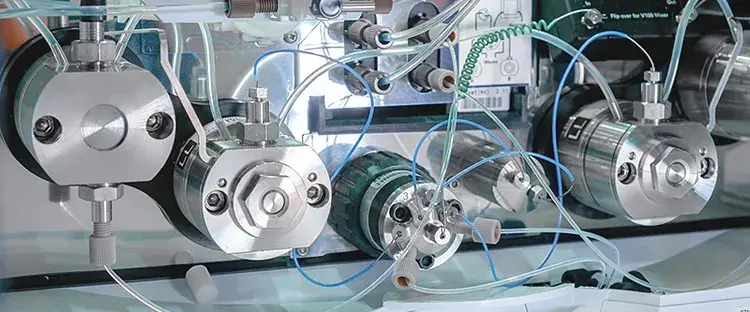
An HPLC detector is positioned downstream from the chromatographic column and measures compounds as they elute from the separation system. As each compound reaches the detector, it generates a signal that can be used to produce a chromatogram and determine factors such as retention time, concentration, and relative abundance. Different detector technologies respond to different physical or chemical properties. Some measure light absorption, while others detect fluorescence, refractive index changes, scattered light, or aerosolized particles. This means there is no single detector that is ideal for every HPLC application. For buyers, detector selection should begin with the sample rather than the instrument brand. The analytes being measured, required sensitivity, mobile phase, concentration range, and method requirements all influence which detector technology provides the best fit.
UV/Vis HPLC Detectors
UV/Vis detectors are among the most common HPLC detectors because many organic compounds absorb ultraviolet or visible light. These detectors measure changes in absorbance as compounds pass through a flow cell. UV/Vis detection is widely used for pharmaceutical compounds, organic molecules, chemicals, proteins, and many routine quality-control methods. Fixed or variable-wavelength configurations allow laboratories to select a wavelength that provides good sensitivity for the target analyte. For buyers, UV/Vis detectors are often one of the most versatile and cost-effective choices for general HPLC work. However, compounds that do not absorb strongly in the UV or visible range may require another detector technology.
Photodiode Array and Diode Array Detectors
A photodiode array detector (PDA) or diode array detector (DAD) measures absorbance across multiple wavelengths simultaneously rather than monitoring only one selected wavelength. This allows laboratories to collect spectral information in addition to conventional chromatographic data. PDA detectors are especially useful in pharmaceutical development, impurity analysis, method development, compound identification, and applications where peak purity is important. The ability to compare absorbance spectra across a chromatographic peak can provide more analytical information than a standard variable-wavelength detector. For buyers, a PDA detector can be a strong choice when method flexibility and spectral confirmation are important. It is generally more sophisticated than a basic UV detector, making it especially useful in research, pharmaceutical QC, and analytical development laboratories.
Fluorescence Detectors
HPLC fluorescence detectors measure light emitted by fluorescent compounds after they are excited at a specific wavelength. Because the detector looks for emitted fluorescence rather than simple absorbance, fluorescence detection can provide excellent sensitivity and selectivity. Fluorescence detectors are commonly used for compounds that naturally fluoresce as well as analytes that can be chemically derivatized with fluorescent labels. Applications include pharmaceutical analysis, amino acids, proteins, environmental testing, food analysis, and biological samples. For buyers working with trace-level compounds, a fluorescence detector can provide much better sensitivity than conventional UV detection when the analyte is suitable. The tradeoff is that not every compound fluoresces, so application compatibility should be confirmed before purchase.
Refractive Index Detectors 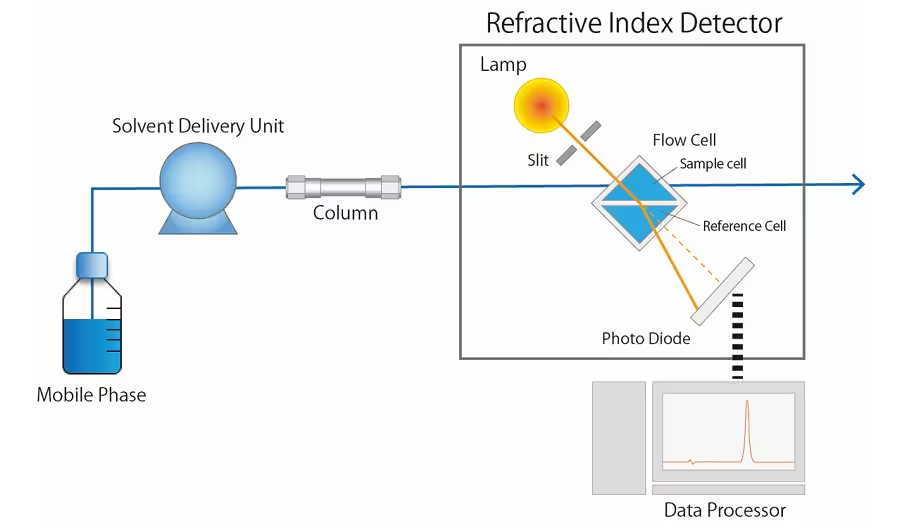
Refractive index detectors, often called RI or RID detectors, measure changes in the refractive index of the mobile phase as analytes pass through the detector. They are commonly used for compounds that do not have useful UV absorbance. Typical applications include sugars, carbohydrates, polymers, alcohols, and other compounds that can be difficult to detect with UV-based systems. RI detectors are frequently used in food, polymer, chemical, and pharmaceutical laboratories. For buyers, an RI detector offers broad compound compatibility but generally provides lower sensitivity than fluorescence or UV-based detection. It is also more sensitive to temperature and mobile-phase composition, making stable operating conditions important.
Evaporative Light Scattering Detectors
An evaporative light scattering detector (ELSD) is a near-universal HPLC detector used for compounds that do not absorb UV light. The detector nebulizes the column effluent, evaporates the mobile phase, and measures light scattered by the remaining analyte particles. ELSD is commonly used for lipids, surfactants, carbohydrates, natural products, polymers, and other nonvolatile compounds. Because detection is based on particles rather than optical absorbance, it can be useful for analytes that are difficult to detect with UV or fluorescence methods. For buyers, ELSD can expand the range of compounds that an existing HPLC system can analyze. Mobile-phase volatility and analyte characteristics should be considered carefully, since the technique requires evaporation of the mobile phase.
Charged Aerosol Detectors
Charged aerosol detectors (CAD) are another broadly applicable detector technology for nonvolatile and semi-volatile analytes. The mobile phase is nebulized and evaporated, and the remaining analyte particles are electrically charged before being measured. CAD is widely used in pharmaceutical analysis, impurity testing, lipids, carbohydrates, surfactants, excipients, and compounds that lack strong UV chromophores. It is valued for relatively consistent response across many different analyte classes. For buyers looking for broader detection capability, CAD can be a strong alternative to ELSD. These systems are particularly useful when multiple chemically diverse compounds must be measured within the same analytical workflow.
Which HPLC Detector Is Best for Your Application?
The best detector depends primarily on what the laboratory needs to measure. A pharmaceutical QC lab analyzing UV-active compounds may be well served by a UV or PDA detector, while a lab analyzing sugars may need RI detection. A facility working with trace fluorescent compounds may benefit from fluorescence detection, while lipid, surfactant, or excipient analysis may favor ELSD or CAD. In many advanced laboratories, multiple detectors are used because different methods require different detection technologies. For buyers, it is important to consider not only detector sensitivity but also mobile-phase compatibility, sample concentration, software integration, flow-cell configuration, and compatibility with the existing HPLC platform.
What Buyers Should Consider
When purchasing a used HPLC detector, buyers should evaluate both the detector technology and the exact system configuration.
Important considerations include:
- Detector type
- Wavelength range or detection principle
- Sensitivity and detection limits
- Flow-cell condition
- Software compatibility
- Communication interface
- HPLC system compatibility
- Lamp or consumable condition
- Included cables and accessories
- Overall operating condition
Compatibility is especially important when adding a detector to an existing HPLC system. Buyers should confirm that the detector can communicate with the chromatography data system and that tubing, flow cells, signal connections, and software are compatible with the rest of the platform.
A complete detector that includes the correct flow cell, lamp, cables, software support, and accessories can offer much better value than a lower-cost unit that requires additional components before it can be used.
Recommended HPLC Detectors by Type
Below are well-known HPLC detector models representing the major detector technologies used in analytical laboratories. 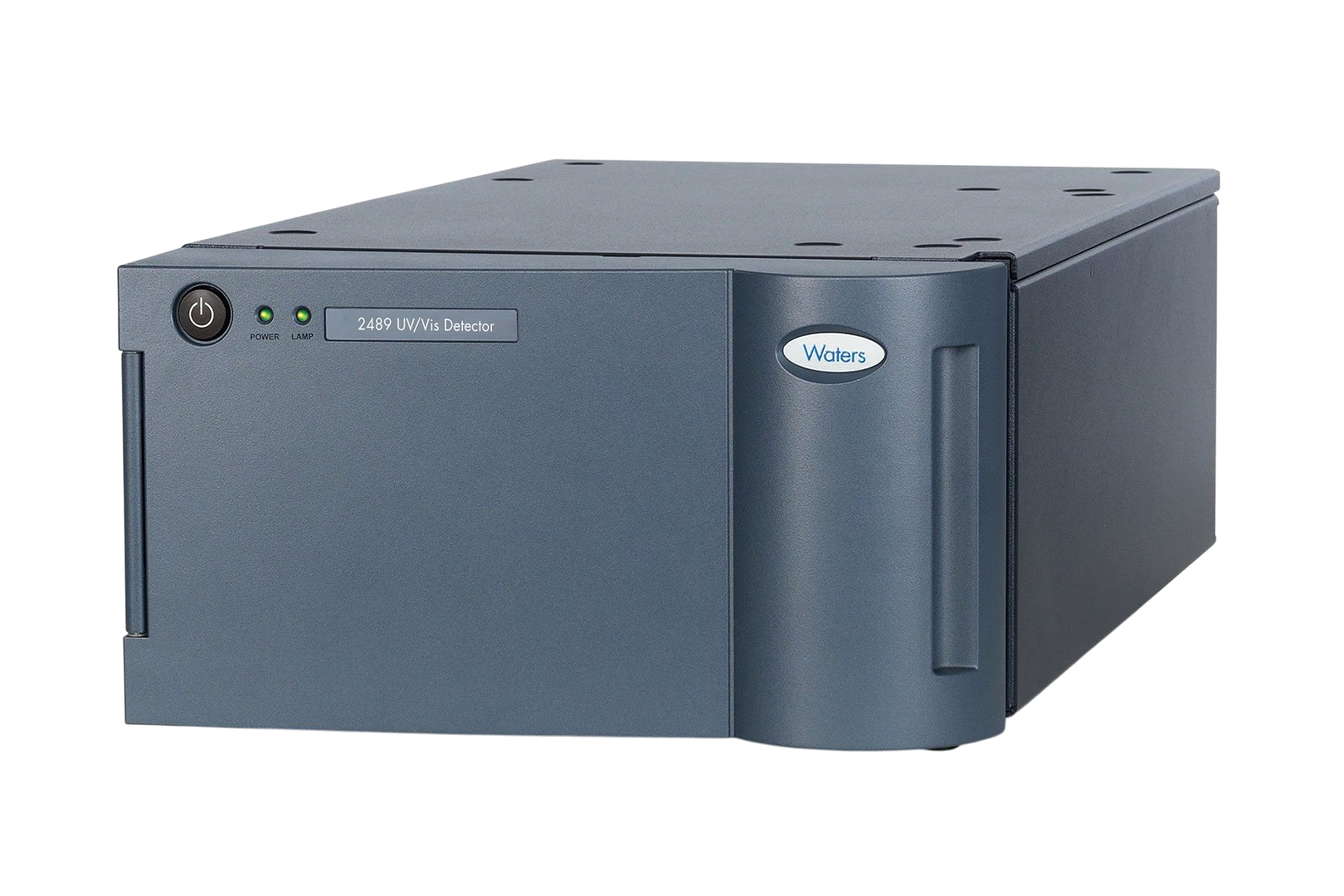
UV/Vis Detector – Waters 2489 UV/Visible Detector – A widely recognized dual-wavelength HPLC detector used for routine pharmaceutical, chemical, and research applications. It is a strong general-purpose choice for analytes with suitable UV or visible absorbance.
PDA Detector – Waters 2998 Photodiode Array Detector – A popular PDA detector used for spectral analysis, peak purity evaluation, impurity profiling, and pharmaceutical method development. It is commonly paired with Waters Alliance and other liquid chromatography platforms.
Fluorescence Detector – Waters 2475 Multi Fluorescence Detector – A well-known HPLC fluorescence detector designed for sensitive and selective analysis of fluorescent compounds. It is commonly used in pharmaceutical, environmental, biochemical, and food analysis where low detection limits are important.
Refractive Index Detector – Waters 2414 Refractive Index Detector – A widely used RI detector for carbohydrates, sugars, polymers, and other compounds that do not respond strongly to UV detection.
ELSD – Waters 2424 Evaporative Light Scattering Detector – A recognized ELSD platform used for nonvolatile analytes such as lipids, surfactants, carbohydrates, and compounds without useful UV absorbance.
Charged Aerosol Detector – Thermo Scientific Corona Veo CAD – A popular charged aerosol detector used for broad-range detection of nonvolatile and semi-volatile compounds in pharmaceutical, chemical, and research workflows.
Choosing the Right HPLC Detector
The right HPLC detector depends on the analyte, sensitivity requirements, mobile phase, method, and existing chromatography platform. UV and PDA detectors remain strong general-purpose choices, while fluorescence, RI, ELSD, and CAD provide specialized advantages for compounds that are difficult to measure with standard absorbance detection. Buyers should focus on practical compatibility rather than simply choosing the most advanced detector available. A detector that matches the laboratory’s sample types and current HPLC system will usually provide better value than one with capabilities that are rarely used.
By comparing detector technology, sensitivity, software compatibility, accessories, and overall condition, laboratories can select an HPLC detector that expands analytical capability while keeping acquisition and operating costs under control.
Looking for HPLC Detectors & Chromatography Equipment?
Explore our inventory of used HPLC detectors, fluorescence detectors, PDA detectors, UV/Vis detectors, and chromatography systems, or consign your surplus analytical equipment to reach qualified buyers.
Visit us at ReBio.com to request a free valuation
📦 Worldwideshipping available